Romantic Comedies of the 1940s Such as Bringing Up Baby, It Happened One Night, and His Girl Friday
At first glance, director Howard Hawks' two raucous romantic comedies, Bringing Up Baby (1938) and His Girl Fri (1940), are all-time known for having in common their leading man (Cary Grant), potent roles for women, and longstanding popularity (currently both are 8/10 on IMDb). When considered through film genre and narrative, however, we can run across that they share even more than.
I would identify both pictures equally anti-domesticity narratives, tales that resist traditionally gendered romantic endings. In classic Hollywood film, romances and romantic comedies more often than not end with the female lead entirely tamed. Whether she began as a rebel or a shy ingénue, she finishes every bit an imminent or contented housewife and future mother. In an anti-domesticity narrative, the adult female demands something more or other than abode life, and the human being agrees. His acquiescence may occur because he has a progressive view of marriage, because he has fastened himself to a forcefulness of nature he cannot resist, or considering his needs are best fulfilled with a non-traditional wife. Such specifics may vary, only the romance must withal culminate in some promise of happily-e'er-later.
His Daughter Friday, which follows a female "paper man" who realizes she cannot abandon the profession she loves for a future every bit a housewife (and meanwhile falls back in love with her newspaper man ex-married man), earns its anti-domesticity credentials more easily than Bringing Up Babe, in role because of the stage play it is based on. The 1928 Broadway play The Front end Page tells the adventures of two competitive male tabloid reporters. In the original 1931 film version, both the title and the gender of the main characters remain intact. Yet, while the competition remains in the 1940 film adaptation, the duo is inverse to male person-female. The rewrite heightens tension by emphasizing the quondam wedlock of the two, even as it creates a dynamic, not-traditional female protagonist, played by Rosalind Russell.
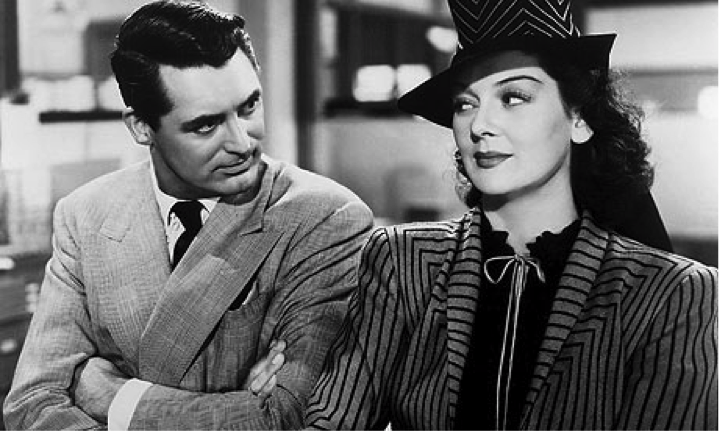
Walter (Cary Grant) and Hildy (Rosalind Russell) spur and spark in His Daughter Fri (1940)
Both films are examples of the subgenre of "screwball" comedy, a Hollywood romantic one-act of the 1930s or 40s that includes quick repartee and farce within a "battle of the sexes" that ends in successful romance. Screwball elements frame the anti-domesticity narrative well, using wide one-act to soften the touch of the social critique. Moreover, the divorce links His Girl Friday with the "comedy of remarriage," identified by Stanley Cavell as a subgenre of screwball comedy in which the main characters divorce, dally with others (without breaking Hays Code prohibitions against adultery) and and so remarry under more equal terms.
Whether or non we agree that Hildy and Walter have equal power at the terminate of the film, nosotros see that Hildy ultimately rejects domestic bliss with one-time-fashioned Bruce Baldwin (Ralph Bellamy), who planned to take her away from her hectic career in a hectic city to exist a happy housewife in upstate New York. Although she will have to surrender any hopes of peace and serenity, Hildy, like Walter, clearly prefers the excitement and adventure of the newspaper trade equally part of any romantic relationship. She returns to Walter simply stays a journalist, and that is the heart of this anti-domesticity narrative.
Bringing Up Infant, the before of the two films, resists narratives of domesticity less patently but in some ways more radically than His Girl Fri. Walter tricks and coerces Hildy into leaving Bruce, fulfilling a traditional aggressive masculine part. Hildy is Walter'southward equal in vitriol, but Walter dominates her life, leading Hildy back to his artillery and where he wants her. That he wants her in the newspaper game, chasing leads rather than changing diapers, links the film with the anti-domesticity narrative only does not erase the gendered power imbalance between them. By contrast, in Bringing Up Baby, the female person is the aggressor who gets what she wants from the man she chooses (and chases) throughout this anti-domesticity tale.

Susan (Katharine Hepburn) takes David (Cary Grant) on an gamble to non-traditional romance in Bringing Upwardly Baby (1938)
In comparison to Russell's Hildy Johnson, Hepburn'south Susan Vance is not a career woman. Her inherited wealth and form privilege permit her to spend her time as she wishes, engaged in activities such every bit golfing and dining at the club. The man she pursues afterward a comedy-of-errors style introduction is Cary Grant's Dr. David Huxley, a shy, bookish homo who is all piece of work and no play. The bespectacled scientist David is concerned only with his work in paleontology. And when he occasionally thinks of other matters, such as romance, he is quickly put in his place past his prim banana-cum fiancée, Alice Consume (Virginia Walker), who is even more work-driven than David. Her plans for their marital elation demand "no entanglements of any kind," including sexual intimacy and the offspring that might produce. While both characters oppose the traditional domesticated blazon, Miss Swallow displays no pleasance in what she does, only a adamant sense of duty. Susan, on the other hand, seems to seek only pleasure, and the pursuit of pleasance triumphs in this film.
A central symbol of resistance to domesticity is the film's titular "baby," which turns out to be a tamed leopard that Susan's brother has sent to her for safekeeping. Domesticity is exchanged for slapstick wildness, and Susan takes David on the ride of his life. Susan shows no predisposition toward domestic bliss across claiming the man she loves and enjoying the chaos. Her perspective is echoed in the jazz standard they repeatedly sing to at-home the leopard:
I can't give y'all anything just dear, baby
That's the only thing I've plenty of, baby
Dream a while, scheme a while
I'one thousand sure you'll find
Happiness, and I gauge
All those things you've ever pined for
Susan tin be neither the traditional housewife nor the terse bride who volition ensure his career flourishes. She offers only a crazy kind of dear, just it turns out that's what's best for tightly wound David. In the concluding scene, Susan destroys David's dinosaur and so speaks for him, offering his words of forgiveness and declaration of beloved. She's the dreamer and the schemer of the song, and she has led him to recognize that what he'south "always pined for" is the chaos she offers. David's resigned "Oh well" and embrace in response is in many means the equal and opposite of Hildy's resignation as she realizes Walter will never take her on a honeymoon though neither will he condemn her to the life of a housewife. David's reciprocating Susan's beloved is portrayed every bit more of a capitulation than an agile option. In this resolution, we see that Susan and David have reversed traditional gender roles, non in a career sense just in an intra-relational sense, whereas Hildy and Walter all the same follow some of our assumptions about masculine and feminine behavior within couples.
Past considering these 2 screwball comedies together, we run into similar challenges to the gender politics of domesticity within different narratives. Hildy is the career woman encouraged to recognize her destiny past a manipulative man. Susan is manipulative, too, but she's also a free spirit who leads her homo to savour a non-traditional romance. In Hawks' famous pair of romantic comedies, then, we get Hollywood happily-ever-afters that neatly avoid the relegation of women to marriage and the home.
Source: https://the-take.com/watch/what-do-bringing-up-baby-and-his-girl-friday-have-in-common
0 Response to "Romantic Comedies of the 1940s Such as Bringing Up Baby, It Happened One Night, and His Girl Friday"
Post a Comment