Cannot Read Property 'open' of Undefined Modal
An ontological argument is a philosophical argument, fabricated from an ontological basis, that is advanced in support of the existence of God. Such arguments tend to refer to the state of beingness or existing. More than specifically, ontological arguments are unremarkably conceived a priori in regard to the arrangement of the universe, whereby, if such organizational structure is truthful, God must exist.
The outset ontological statement in Western Christian tradition[i] was proposed past Saint Anselm of Canterbury in his 1078 work, Proslogion (Latin: Proslogium, lit.'Discourse on the Existence of God'), in which he defines God as "a existence than which no greater tin be conceived," and argues that such being must exist in the mind, even in that of the person who denies the existence of God.[1] From this, he suggests that if the greatest possible existence exists in the mind, it must also exist in reality, considering if it existed only in the listen, then an even greater being must be possible—one who exists both in mind and in reality. Therefore, this greatest possible being must be in reality. Similarly, in the East, Avicenna's Proof of the Truthful argued that there must exist a "necessary existent".[two]
Since its initial proposal, few philosophical ideas have generated as much interest and discussion as the ontological argument. Nearly all of the keen minds in Western philosophy have constitute it worthy of their attention. Seventeenth-century French philosopher René Descartes employed a similar argument to Anselm's. Descartes published several variations of his argument, each of which center on the idea that God'southward existence is immediately inferable from a "clear and singled-out" idea of a supremely perfect being. In the early 18th century, Gottfried Leibniz augmented Descartes' ideas in an attempt to testify that a "supremely perfect" being is a coherent concept. A more recent ontological argument came from Kurt Gödel, who proposed a formal statement for God's existence. Norman Malcolm revived the ontological statement in 1960 when he located a second, stronger ontological argument in Anselm's piece of work; Alvin Plantinga challenged this statement and proposed an culling, based on modal logic. Attempts have also been fabricated to validate Anselm'due south proof using an automated theorem prover. Other arguments take been categorised as ontological, including those made past Islamic philosophers Mulla Sadra and Allama Tabatabai. Christopher Langan also combined ontology with epistemology in his work, as an extension of John Archibald Wheeler's Participatory Anthropic Principle.
Just as the ontological argument has been popular, a number of criticisms and objections take also been mounted. Its first critic would be Gaunilo of Marmoutiers, a contemporary of Anselm's. Gaunilo, suggesting that the ontological argument could be used to prove the existence of anything, uses the analogy of a perfect isle. Such would be the first of many parodies, all of which attempted to show the absurd consequences of the ontological statement. Later, Thomas Aquinas rejected the argument on the basis that humans cannot know God's nature. David Hume also offered an empirical objection, criticising its lack of evidential reasoning and rejecting the thought that annihilation tin exist necessarily. Immanuel Kant'south critique was based on what he saw as the imitation premise that beingness is a predicate, arguing that "existing" adds zip (including perfection) to the essence of a being. Thus, a "supremely perfect" being can be conceived non to exist. Finally, philosophers such as C. D. Broad dismissed the coherence of a maximally neat being, proposing that some attributes of greatness are incompatible with others, rendering "maximally smashing existence" incoherent.
Gimmicky defenders of the ontological argument include Alvin Plantinga, Yujin Nagasawa, and Robert Maydole.
Classification [edit]
The traditional definition of an ontological argument was given by Immanuel Kant.[3] He contrasted the ontological statement (literally any statement "concerned with beingness")[iv] with the cosmological and physio-theoretical arguments.[5] Co-ordinate to the Kantian view, ontological arguments are those founded through a priori reasoning.[3]
Graham Oppy, who elsewhere expressed that he "encounter[southward] no urgent reason" to depart from the traditional definition,[three] defined ontological arguments as those which begin with "nothing just analytic, a priori and necessary premises" and conclude that God exists. Oppy admits, even so, that non all of the "traditional characteristics" of an ontological argument (i.e. analyticity, necessity, and a priority) are establish in all ontological arguments[1] and, in his 2007 work Ontological Arguments and Belief in God, suggested that a better definition of an ontological argument would employ only considerations "entirely internal to the theistic worldview."[3]
Oppy subclassified ontological arguments, based on the qualities of their premises, using the following qualities:[1] [3]
- definitional: arguments that invoke definitions.
- conceptual (or hyperintensional): arguments that invoke "the possession of certain kinds of ideas or concepts."
- modal: arguments that consider possibilities.
- meinongian: arguments that assert "a distinction between different categories of existence."
- experiential: arguments that employ the thought of God existing solely to those who have had feel of him.
- mereological: arguments that "draw on…the theory of the whole-function relation."[vi]
- higher-order: arguments that observe "that any collection of backdrop, that (a) does non include all properties and (b) is closed nether entailment, is peradventure jointly instantiated."
- Hegelian: the arguments of Hegel.
William Lane Craig criticised Oppy's written report as too vague for useful nomenclature. Craig argues that an argument tin be classified equally ontological if it attempts to deduce the existence of God, forth with other necessary truths, from his definition. He suggests that proponents of ontological arguments would claim that, if one fully understood the concept of God, one must accept his existence.[7]
William L. Rowe defines ontological arguments every bit those which start from the definition of God and, using only a priori principles, conclude with God'south existence.[8]
Development [edit]
Although a version of the ontological argument appears explicitly in the writings of the ancient Greek philosopher Xenophanes and variations announced in writings by Parmenides, Plato, and the Neoplatonists,[9] the mainstream view is that the ontological argument was first conspicuously stated and developed by Anselm of Canterbury.[1] [x] [xi] Some scholars contend that Islamic philosopher Avicenna (Ibn Sina) developed a special kind of ontological argument before Anselm,[12] [13] while others have doubted this position.[14] [xv] [sixteen]
Daniel Dombrowski marked three major stages in the evolution of the argument:[17]
- Anselm's initial explicit formulation;
- the 18th-century criticisms of Kant and Hume; and
- the identification of a second ontological argument in Anselm's Proslogion by 20th-century philosophers.
Anselm [edit]
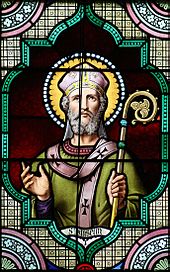
Theologian and philosopher Anselm of Canterbury (1033–1109) proposed an ontological argument in the 2nd and 3rd chapters of his Proslogion.[eighteen] Anselm'south statement was non presented in order to prove God's existence; rather, Proslogion was a piece of work of meditation in which he documented how the idea of God became cocky-evident to him.[19]
In Chapter 2 of the Proslogion, Anselm defines God as a "being than which no greater can be conceived."[1] While Anselm has oft been credited as the beginning to empathize God as the greatest possible being, this perception was actually widely described amongst ancient Greek philosophers and early on Christian writers.[20] [21] He suggests that fifty-fifty "the fool" can empathise this concept, and this understanding itself means that the being must be in the mind. The concept must exist either only in our listen, or in both our listen and in reality. If such a being exists only in our mind, and so a greater being—that which exists in the mind and in reality—tin can be conceived (this statement is generally regarded every bit a reductio advertizement absurdum because the view of the fool is proven to be inconsistent). Therefore, if we can conceive of a being than which nil greater can be conceived, it must exist in reality. Thus, a beingness than which nothing greater could exist conceived, which Anselm defined as God, must exist in reality.[22]
Anselm'southward argument in Affiliate 2 can be summarized as follows:[23]
- Information technology is a conceptual truth (or, so to speak, true by definition) that God is a being than which none greater can be imagined (that is, the greatest possible being that can be imagined).
- God exists as an thought in the mind.
- A being that exists as an thought in the listen and in reality is, other things being equal, greater than a beingness that exists only every bit an idea in the listen.
- Thus, if God exists merely as an idea in the mind, then we can imagine something that is greater than God (that is, a greatest possible being that does be).
- But nosotros cannot imagine something that is greater than God (for it is a contradiction to suppose that we can imagine a being greater than the greatest possible beingness that can exist imagined.)
- Therefore, God exists.
In Chapter 3, Anselm presents a further statement in the same vein:[23]
- By definition, God is a being than which none greater tin exist imagined.
- A being that necessarily exists in reality is greater than a existence that does non necessarily exist.
- Thus, by definition, if God exists as an idea in the heed but does not necessarily be in reality, then we tin can imagine something that is greater than God.
- Simply we cannot imagine something that is greater than God.
- Thus, if God exists in the heed equally an thought, then God necessarily exists in reality.
- God exists in the mind as an thought.
- Therefore, God necessarily exists in reality.
This contains the notion of a existence that cannot be conceived non to exist. He argued that if something can be conceived not to be, then something greater can be conceived. Consequently, a thing than which nothing greater can be conceived cannot be conceived non to be and and then it must exist. This can be read as a restatement of the argument in Chapter 2, although Norman Malcolm believes it to be a different, stronger argument.[24]
René Descartes [edit]
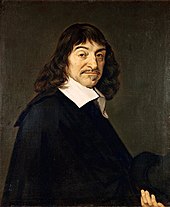
French thinker René Descartes proposed several arguments that could exist termed ontological.
René Descartes (1596–1650) proposed a number of ontological arguments that differ from Anselm's conception. By and large speaking, they are less formal arguments than they are natural intuition.
In Meditation, Book V, Descartes wrote:[25]
Just, if the mere fact that I can produce from my thought the idea of something entails that everything that I clearly and distinctly perceive to belong to that thing really does belong to information technology, is non this a possible basis for some other statement to prove the existence of God? Certainly, the idea of God, or a supremely perfect being, is ane that I observe within me just as surely equally the idea of any shape or number. And my understanding that it belongs to his nature that he always exists is no less clear and distinct than is the case when I prove of whatever shape or number that some property belongs to its nature.
Descartes argues that God's existence can exist deduced from his nature, merely as geometric ideas tin can be deduced from the nature of shapes—he used the deduction of the sizes of angles in a triangle as an example. He suggested that the concept of God is that of a supremely perfect being, holding all perfections. He seems to have assumed that existence is a predicate of a perfection. Thus, if the notion of God did non include existence, it would not be supremely perfect, equally information technology would exist lacking a perfection. Consequently, the notion of a supremely perfect God who does not be, Descartes argues, is unintelligible. Therefore, according to his nature, God must exist.[26]
Baruch Spinoza [edit]
In Spinoza's Ethics, he wrote a section titled "Treating of God and What Pertains to Him", in which he discusses God'southward beingness and what God is. He starts off by saying: "whether there is a God, this, nosotros say, can be proved".[27] His proof for God follows a similar construction as Descartes' ontological argument. Descartes attempts to prove God's existence by arguing that there "must exist some one thing that is supremely skilful, through which all adept things accept their goodness".[28] Spinoza'southward argument differs in that he does not motility straight from the conceivability of the greatest being to the existence of God, but rather uses a deductive statement from the thought of God. Spinoza says that human's ideas practice not come from himself, merely from some sort of external crusade. Thus the things whose characteristics a homo knows must have come from some prior source. Then, if man has the idea of God, then God must exist before this thought, because man cannot create an idea of his own imagination.[27]
More specifically, on the St Anselm'south statement he wrote:
Logically it can be stated in a variety of means: any soapbox marks off a realm of soapbox in such wise that any consistent statement indicates a real and intelligible nature. Or stated more than rigorously: a postulate may be formulated such that from it and from the definitions involved it its statement a proposition may be deduced concerning the nature of the reality in which such a postulate is possible; the truth of that proffer would follow non from assent to the postulate but from the very beingness of the postulate. For thinking to be possible, it is said in effect, there must exist an infinite perfect being. Simply to formulate such a postulate is an human action of thought; it must, co-ordinate to its ain argument, be referred to a perfect intelligible being who is implicated in any argument. Yet knowledge of his nature volition be independent of the truth or falsity of other statements; in fact, although the beingness of God is outset indicated in these statements, once it is knov/n such knowledge will not depend on the truth or falsify of the statements, only on the contrary their truth or falsity will depend on the nature of God. Fifty-fifty the archaic postulate is no longer postulated but is fabricated apodictic by the ameliorate attested truth of God's existence.
Gottfried Leibniz [edit]
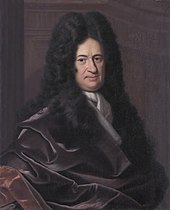
High german philosopher Gottfried Leibniz attempted to testify the coherence of a "supremely perfect being".
Gottfried Wilhelm Leibniz saw a problem with Descartes' ontological argument: that Descartes had not asserted the coherence of a "supremely perfect" existence. He proposed that, unless the coherence of a supremely perfect existence could be demonstrated, the ontological argument fails. Leibniz saw perfection equally impossible to analyse; therefore, it would be impossible to demonstrate that all perfections are incompatible. He reasoned that all perfections tin can exist together in a single entity, and that Descartes' statement is notwithstanding valid.[31]
Mulla Sadra [edit]
Mulla Sadra (c. 1571/two – 1640) was an Iranian Shia Islamic philosopher who was influenced past earlier Muslim philosophers such equally Avicenna and Suhrawardi, likewise as the Sufi metaphysician Ibn 'Arabi. Sadra discussed Avicenna's arguments for the existence of God, claiming that they were non a priori. He rejected the argument on the footing that existence precedes essence, or that the existence of human beings is more than fundamental than their essence.[32]
Sadra put forwards a new argument, known as Seddiqin Argument or Argument of the Righteous. The argument attempts to prove the existence of God through the reality of beingness, and to conclude with God's pre-eternal necessity. In this argument, a thing is demonstrated through itself, and a path is identical with the goal. In other arguments, the truth is attained from an external source, such as from the possible to the necessary, from the originated to the eternal origin, or from motion to the unmoved mover. In the statement of the righteous, there is no middle term other than the truth.[33] His version of the ontological argument can be summarized as follows:[32]
- At that place is being
- Existence is a perfection to a higher place which no perfection may be conceived
- God is perfection and perfection in existence
- Existence is a singular and simple reality; there is no metaphysical pluralism
- That singular reality is graded in intensity in a calibration of perfection (that is, a denial of a pure monism).
- That scale must have a limit point, a signal of greatest intensity and of greatest beingness.
- Hence God exists.
Mulla Sadra describes this statement in his primary work al-asfar al-arba'a [four journeys] equally follows:
Existence is a unmarried, objective and simple reality, and in that location is no departure between its parts, unless in terms of perfection and imperfection, forcefulness, and weakness... And the culmination of its perfection, where there is nothing more perfect, is its independence from any other affair. Nothing more perfect should be believable, as every imperfect affair belongs to another affair and needs this other to become perfect. And, as it has already been explicated, perfection is prior to imperfection, actuality to potency, and existence to non-being. As well, it has been explained that the perfection of a thing is the thing itself, and not a thing in addition to it. Thus, either existence is independent of others or it is in need of others. The old is the Necessary, which is pure existence. Goose egg is more perfect than Him. And in Him there is no room for non-existence or imperfection. The latter is other than Him, and is regarded every bit His acts and effects, and for other than Him in that location is no subsistence, unless through Him. For there is no imperfection in the reality of beingness, and imperfection is added to being only because of the quality of being caused, every bit it is impossible for an issue to be identical with its cause in terms of existence.[34]
G.W.F. Hegel [edit]
In response to Kant's rejection of traditional speculative philosophy in his First Critique, and to Kant's rejection of the Ontological Statement, Chiliad.West.F. Hegel proposed throughout his lifetime works that Immanuel Kant was mistaken. Hegel took aim at Kant's famous $100 argument. Kant had said that "it is one thing to have $100 in my mind, and quite a different matter to have $100 in my pocket." Co-ordinate to Kant, we tin imagine a God, simply that doesn't prove that God exists.
Hegel argued that Kant's formulation was inaccurate. Hegel referred to Kant's error in all of his major works from 1807 to 1831. For Hegel, "The True is the Whole" (PhG, para. 20). For Hegel, the True is the Geist which is to say, Spirit, which is to say, God. Thus God is the Whole of the Cosmos, both unseen also as seen. This mistake of Kant, therefore, was his comparison of a finite (contingent) entity such as $100, with Space (necessary) Being, i.e. the Whole.
When regarded as the Whole of Being, unseen every bit well as seen, and not but "one beingness amid many," so the Ontological Statement flourishes, and its logical necessity become obvious, co-ordinate to Hegel.
The final book contract that Hegel signed in the twelvemonth that he died, 1831, was for a book entitled, Lectures on the Proofs of the Existence of God. Hegel died earlier finishing the book. Information technology was to have 3 sections: (i) The Cosmological Argument; (2) The Teleological Argument; and (3) the Ontological Argument. Hegel died before beginning sections two and 3. His piece of work is published today as incomplete, with just part of his Cosmological Argument intact.
To peruse Hegel'southward ideas on the Ontological Argument, scholars have had to piece together his arguments from various paragraphs from his other works. Sure scholars have suggested that all of Hegel'south philosophy composes an ontological argument.[35] [36]
Kurt Gödel [edit]
Mathematician Kurt Gödel provided a formal argument for God's existence. The argument was constructed by Gödel simply non published until long after his death. He provided an statement based on modal logic; he uses the conception of backdrop, ultimately last with God's existence.[37]
Definition one: 10 is God-similar if and only if ten has as essential properties those and merely those properties which are positive
Definition 2: A is an essence of x if and only if for every property B, x has B necessarily if and simply if A entails B
Definition 3: ten necessarily exists if and only if every essence of ten is necessarily exemplified
Precept 1: If a property is positive, then its negation is non positive
Precept 2: Any property entailed by—i.eastward., strictly implied by—a positive property is positive
Axiom 3: The property of existence God-similar is positive
Axiom 4: If a property is positive, and so it is necessarily positive
Precept 5: Necessary being is positive
Axiom 6: For any property P, if P is positive, then being necessarily P is positive
Theorem 1: If a belongings is positive, then it is consistent, i.due east., maybe exemplified
Corollary 1: The property of being God-similar is consistent
Theorem 2: If something is God-like, then the property of beingness God-like is an essence of that thing
Theorem three: Necessarily, the belongings of being God-similar is exemplified
Gödel divers being "god-similar" as having every positive property. He left the term "positive" undefined. Gödel proposed that it is understood in an aesthetic and moral sense, or alternatively as the opposite of privation (the absence of necessary qualities in the universe). He warned against interpreting "positive" as being morally or aesthetically "good" (the greatest advantage and least disadvantage), as this includes negative characteristics. Instead, he suggested that "positive" should be interpreted as beingness perfect, or "purely practiced", without negative characteristics.[38]
Gödel's listed theorems follow from the axioms, then most criticisms of the theory focus on those axioms or the assumptions made. For example, precept five does not expain why necessary existence is positive instead of possible existence, an precept which the whole argument follows from. Or, for Axiom 1, to use another example, the negation of a positive property both includes the lack of whatsoever properties and the opposite property, and but the lack of any properties is a privation of a belongings, not the opposite belongings (for instance, the lack of happiness can symbolize either sadness or having no emotion, merely only lacking emotion could be seen as a privation, or negative property). Either of these axioms beingness seen as not mapping to reality would cause the whole argument to neglect. Oppy argued that Gödel gives no definition of "positive properties". He suggested that if these positive backdrop class a ready, there is no reason to believe that any such fix exists which is theologically interesting, or that in that location is simply one prepare of positive properties which is theologically interesting.[37]
Modal versions of the ontological argument [edit]
Modal logic deals with the logic of possibility too as necessity. Paul Oppenheimer and Edward N. Zalta annotation that, for Anselm's Proslogion chapter 2, "Many recent authors have interpreted this argument as a modal one." In the phrase 'that than which none greater can exist conceived', the word 'tin' could exist construed as referring to a possibility. All the same, the authors write that "the logic of the ontological statement itself doesn't include inferences based on this modality."[39] All the same, there take been newer, avowedly modal logic versions of the ontological statement, and on the application of this blazon of logic to the statement, James Franklin Harris writes:
[D]ifferent versions of the ontological argument, the so-called "modal" versions of the argument, which arguably avoid the part of Anselm'south argument that "treats beingness as a predicate," began to emerge. The [modal logic version] of these forms of defense force of the ontological argument has been the most significant evolution.[40]
Hartshorne and Malcolm [edit]
Charles Hartshorne and Norman Malcolm are primarily responsible for introducing modal versions of the argument into the gimmicky debate. Both claimed that Anselm had ii versions of the ontological statement, the second of which was a modal logic version. According to James Harris, this version is represented by Malcolm thus:
If it [that than which nothing greater can be conceived] can be conceived at all it must be. For no 1 who denies or doubts the existence of a existence a greater than which is inconceivable, denies or doubts that if it did be its nonexistence, either in reality or in the agreement, would be impossible. For otherwise it would not be a existence a greater than which cannot be conceived. But every bit to whatever can be conceived merely does non exist: if it were to be its nonexistence either in reality or in the understanding would be possible. Therefore, if a being a greater than which cannot be conceived, can even be conceived, it must be.
Hartshorne says that, for Anselm, "necessary existence is a superior manner of existence to ordinary, contingent existence and that ordinary, contingent beingness is a defect." For Hartshorne, both Hume and Kant focused only upon whether what exists is greater than what does not exist. However, "Anselm's bespeak is that what exists and cannot not exist is greater than that which exists and can not exist." This avoids the question of whether or not existence is a predicate.[40]
Referring to the ii ontological arguments proposed by Anselm in Capacity ii and three of his Proslogion, Malcolm supported Kant'southward criticism of Anselm'south statement in Chapter ii: that beingness cannot be a perfection of something. However, he identified what he sees as the 2nd ontological argument in Chapter iii which is not susceptible to such criticism.[41]
In Anselm's second statement, Malcolm identified two key points: start, that a being whose non-existence is logically impossible is greater than a being whose non-being is logically possible, and 2nd, that God is a being "than which a greater cannot be conceived". Malcolm supported that definition of God and suggested that it makes the proposition of God's being a logically necessarily true statement (in the aforementioned way that "a square has four sides" is logically necessarily truthful).[41] Thus, while rejecting the idea of existence itself being a perfection, Malcolm argued that necessary existence is a perfection. This, he argued, proved the existence of an unsurpassably great necessary being.
Jordon Sobel writes that Malcolm is incorrect in assuming that the argument he is expounding is to be plant entirely in Proslogion chapter iii. "Anselm intended in Proslogion Three not an independent argument for the existence of God, but a continuation of the argument of Proslogion II."[42]
Alvin Plantinga [edit]
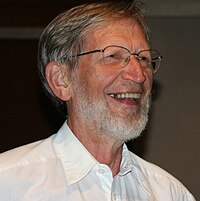
Alvin Plantinga criticized Malcolm'southward and Hartshorne's ontological arguments and proposed a variation of his own.
Christian Analytic philosopher Alvin Plantinga[43] criticized Malcolm's and Hartshorne'southward arguments, and offered an alternative. He argued that, if Malcolm does show the necessary existence of the greatest possible being, it follows that there is a being which exists in all worlds whose greatness in some worlds is not surpassed. Information technology does not, he argued, demonstrate that such a being has unsurpassed greatness in this world.[44]
In an attempt to resolve this problem, Plantinga differentiated between "greatness" and "excellence". A existence'due south excellence in a particular world depends only on its properties in that world; a existence'southward greatness depends on its properties in all worlds. Therefore, the greatest possible existence must take maximal excellence in every possible earth. Plantinga then restated Malcolm's argument, using the concept of "maximal greatness". He argued that it is possible for a being with maximal greatness to exist, so a being with maximal greatness exists in a possible world. If this is the case, then a being with maximal greatness exists in every world, and therefore in this world.[44]
The determination relies on a course of modal precept S5, which states that if something is maybe true, then its possibility is necessary (it is possibly true in all worlds). Plantinga'south version of S5 suggests that "To say that p is maybe necessarily truthful is to say that, with regard to ane world, it is true at all worlds; but in that case it is truthful at all worlds, then it is simply necessary."[45] A version of his argument may be formulated as follows:[31]
- A existence has maximal excellence in a given possible globe Due west if and merely if it is omnipotent, omniscient and wholly good in W; and
- A being has maximal greatness if it has maximal excellence in every possible earth.
- It is possible that there is a being that has maximal greatness. (Premise)
- Therefore, possibly, it is necessarily true that an all-seeing, omnipotent, and perfectly skillful being exists.
- Therefore, (by axiom S5) it is necessarily true that an omniscient, omnipotent and perfectly good existence exists.
- Therefore, an omniscient, omnipotent and perfectly good being exists.
Plantinga argued that, although the offset premise is non rationally established, information technology is not contrary to reason. Michael Martin argued that, if sure components of perfection are contradictory, such as omnipotence and omniscience, so the kickoff premise is contrary to reason. Martin too proposed parodies of the argument, suggesting that the existence of anything can exist demonstrated with Plantinga's argument, provided it is defined equally perfect or special in every possible world.[46]
Another Christian philosopher, William Lane Craig, characterizes Plantinga's argument in a slightly different way:
- It is possible that a maximally great being exists.
- If information technology is possible that a maximally great being exists, then a maximally great beingness exists in some possible world.
- If a maximally great beingness exists in some possible world, then it exists in every possible world.
- If a maximally great being exists in every possible world, then it exists in the actual world.
- If a maximally groovy being exists in the actual world, then a maximally not bad beingness exists.
- Therefore, a maximally great beingness exists.
Co-ordinate to Craig, bounds (2)–(5) are relatively uncontroversial among philosophers, but "the epistemic entertainability of premise (ane) (or its denial) does not guarantee its metaphysical possibility."[47] Furthermore the philosopher Richard G. Gale argued that premise three, the "possibility premise", begs the question. He stated that ane merely has the epistemic right to accept the premise if one understands the nested modal operators, and that if one understands them within the system S5—without which the argument fails—then one understands that "possibly necessarily" is in essence the same as "necessarily".[48] Thus the premise begs the question considering the conclusion is embedded inside it. On S5 systems in general, James Garson writes that "the words 'necessarily' and 'perchance', accept many different uses. And so the acceptability of axioms for modal logic depends on which of these uses we have in mind."[49]
Sankara's dictum [edit]
An arroyo to supporting the possibility premise in Plantinga's version of the argument was attempted by Alexander Pruss. He started with the 8th–9th-century Advertisement Indian philosopher Sankara's dictum that if something is impossible, we cannot have a perception (fifty-fifty a non-veridical one) that it is the case. Information technology follows that if we have a perception that p, then fifty-fifty though it might non be the case that p, it is at least the instance that possibly p. If mystics in fact perceive the existence of a maximally great being, it follows that the existence of a maximally nifty being is at least possible.[50]
Automated reasoning [edit]
Paul Oppenheimer and Edward N. Zalta used an automatic theorem prover—Prover9—to validate Anselm'south ontological thesis. Prover9 after discovered a simpler, formally valid (if not necessarily sound) ontological argument from a single non-logical premise.[51]
Christoph Benzmuller and Bruno Woltzenlogel Paleo used an automated theorem prover to validate Scott'south version of Gödel'south ontological statement. It has been shown by the same researchers that Gödel'south ontological argument is inconsistent. However, Scott's version of Gödel'southward ontological statement is consistent and thus valid.
Other formulations [edit]
The novelist and philosopher Iris Murdoch formulated a version of the ontological argument in her book Metaphysics equally a Guide to Morals. Though she believed her version of the statement to be superior, she did reserve praise for Descartes' formulation. Her statement was phrased by her in the following way:
At that place is no plausible 'proof' of the existence of God except some form of the ontological proof, a 'proof' incidentally which must at present have on an increased importance in theology as a result of the recent 'de-mythologising'. If considered advisedly, however, the ontological proof is seen to be not exactly a proof simply rather a clear assertion of faith (it is often admitted to exist appropriate only for those already convinced), which could only be confidently be made on a certain amount of experience. This assertion could exist put in various ways. The desire for God is certain to receive a response. My conception of God contains the certainty of its own reality. God is an object of love which uniquely excludes doubt and relativism. Such obscure statements would of course receive little sympathy from belittling philosophers, who would dissever their content between psychological fact and metaphysical nonsense.[52]
In other words, atheists may feel objections to such an argument purely on the basis that they rely on a priori methodology. Her formulations rely upon the human connections of God and man, and what such a faith does to people.
Meta-logical arroyo [edit]
The italian journalist Thomas Emilio Villa argues that if we ascertain God equally an entity "than which no greater can exist conceived", then however would exist under a bigger idea, the ones of existence or non-existence. If God is God, must be a greater idea than the one of existence or non-existence. Information technology is across information technology, otherwise the bigger idea is not "God" only the thought of "existence" itself. If God is God, then must exist across the ideas of being and non-being. It must exist a meta-existing being. Therefore the question whether God be or practice non exist is a not-sense: by definition, the idea of God must be beyond existence or its status would non the one of a proper God. Furthermore, if God is God, so it must exist beyond logic, or its status would non be "a existence than which no greater can be conceived", since Logic would be greater than God. By definition, God must exist beyond Logic, and must exist conceived only in a Meta-logical context beyond our logical and necessarily logical approach. Therefore, according to Villa, nosotros cannot deal with the idea of God from our logical approach, and the thought itself of an existing or non existing God is a not-sense by definition.
Criticisms and objections [edit]
Gaunilo [edit]
One of the earliest recorded objections to Anselm's statement was raised past 1 of Anselm's contemporaries, Gaunilo of Marmoutiers. He invited his reader to conceive an island "more excellent" than any other island. He suggested that, according to Anselm'due south proof, this isle must necessarily exist, equally an island that exists would be more than splendid.[53] Gaunilo's criticism does not explicitly demonstrate a flaw in Anselm'south argument; rather, it argues that if Anselm's statement is sound, and so are many other arguments of the same logical class, which cannot be accepted.[54] He offered a further criticism of Anselm's ontological argument, suggesting that the notion of God cannot exist conceived, as Anselm had asserted. He argued that many theists would accept that God, by nature, cannot exist fully comprehended. Therefore, if humans cannot fully conceive of God, the ontological argument cannot work.[55]
Anselm responded to Gaunilo's criticism by arguing that the argument applied only to concepts with necessary beingness. He suggested that only a existence with necessary being can fulfill the remit of "that than which nothing greater can be conceived". Furthermore, a contingent object, such as an island, could always exist improved and thus could never achieve a state of perfection. For that reason, Anselm dismissed whatsoever argument that did non relate to a beingness with necessary being.[53]
Other parodies accept been presented, including the devil corollary, the no devil corollary and the extreme no devil corollary. The devil corollary proposes that a being than which nothing worse can be conceived exists in the understanding (sometimes the term lesser is used in identify of worse). Using Anselm's logical course, the parody argues that if information technology exists in the understanding, a worse being would be 1 that exists in reality; thus, such a beingness exists. The no devil corollary is similar, but argues that a worse being would exist one that does not be in reality, so does not exist. The extreme no devil corollary advances on this, proposing that a worse being would be that which does non exist in the understanding, so such a beingness exists neither in reality nor in the understanding. Timothy Chambers argued that the devil corollary is more powerful than Gaunilo'due south claiming because information technology withstands the challenges that may defeat Gaunilo's parody. He too claimed that the no devil corollary is a strong challenge, as information technology "underwrites" the no devil corollary, which "threatens Anselm's argument at its very foundations".[56]
Thomas Aquinas [edit]
Thomas Aquinas, while proposing five proofs of God'south existence in his Summa Theologica, objected to Anselm's statement. He suggested that people cannot know the nature of God and, therefore, cannot excogitate of God in the mode Anselm proposed.[57] The ontological argument would be meaningful just to someone who understands the essence of God completely. Aquinas reasoned that, as only God can completely know His essence, only He could use the argument.[58] His rejection of the ontological argument led other Catholic theologians to too reject the argument.[59]
David Hume [edit]
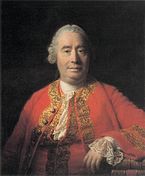
David Hume reasoned that an ontological argument was not possible.
Scottish philosopher and empiricist David Hume argued that nothing can be proven to exist using only a priori reasoning.[lx] In his Dialogues Concerning Natural Religion, the character Cleanthes proposes a criticism:
...in that location is an axiomatic absurdity in pretending to demonstrate a affair of fact, or to prove it by whatever arguments a priori. Nothing is demonstrable, unless the contrary implies a contradiction. Nothing, that is distinctly conceivable, implies a contradiction. Any nosotros conceive as real, we tin also conceive every bit non-existent. There is no being, therefore, whose non-beingness implies a contradiction. Consequently there is no being, whose existence is demonstrable.[61]
Hume also suggested that, equally we take no abstract idea of being (apart from as part of our ideas of other objects), nosotros cannot claim that the idea of God implies his existence. He suggested that any formulation of God we may have, we can conceive either of existing or of non existing. He believed that beingness is not a quality (or perfection), so a completely perfect being need not exist. Thus, he claimed that information technology is not a contradiction to deny God'southward beingness.[60] Although this criticism is directed against a cosmological argument, like to that of Samuel Clarke in his first Boyle Lecture, it has been applied to ontological arguments too.[62]
Immanuel Kant [edit]

Immanuel Kant proposed that existence is not a predicate.
Immanuel Kant put frontward an influential criticism of the ontological argument in his Critique of Pure Reason.[63] His criticism is primarily directed at Descartes, but too attacks Leibniz. Information technology is shaped by his central distinction between analytic and synthetic propositions. In an analytic suggestion, the predicate concept is contained in its subject concept; in a synthetic proposition, the predicate concept is non contained in its subject concept.
Kant questions the intelligibility of the concept of a necessary existence. He considers examples of necessary propositions, such as "a triangle has three angles", and rejects the transfer of this logic to the existence of God. First, he argues that such necessary propositions are necessarily true only if such a being exists: If a triangle exists, it must take iii angles. The necessary proposition, he argues, does not make the being of a triangle necessary. Thus he argues that, if the proposition "10 exists" is posited, it would follow that, if X exists, it exists necessarily; this does not hateful that Ten exists in reality.[64] Second, he argues that contradictions arise only when the predicate is rejected but the subject is maintained and, therefore, a sentence of non-existence cannot be a contradiction, as it denies the bailiwick.[63]
Kant then proposes that the statement "God exists" must exist analytic or synthetic—the predicate must be inside or exterior of the subject, respectively. If the proffer is analytic, as the ontological argument takes it to be, then the argument would be true only considering of the pregnant given to the words. Kant claims that this is just a tautology and cannot say anything well-nigh reality. Yet, if the statement is synthetic, the ontological statement does non work, as the existence of God is non contained within the definition of God (and, equally such, evidence for God would need to be found).[65]
Kant goes on to write, "'being' is manifestly not a real predicate"[63] and cannot be role of the concept of something. He proposes that existence is non a predicate, or quality. This is because beingness does not add to the essence of a being, but merely indicates its occurrence in reality. He states that by taking the subject of God with all its predicates and then asserting that God exists, "I add no new predicate to the conception of God". He argues that the ontological statement works but if existence is a predicate; if this is not and then, he claims the ontological statement is invalidated, every bit information technology is then conceivable a completely perfect being doesn't exist.[23]
In add-on, Kant claims that the concept of God is not one of a detail sense; rather, it is an "object of pure thought".[63] He asserts that God exists outside the realm of experience and nature. Because we cannot feel God through experience, Kant argues that it is incommunicable to know how we would verify God's existence. This is in contrast to material concepts, which tin exist verified past means of the senses.[66]
Douglas Gasking [edit]
Australian philosopher Douglas Gasking (1911–1994) adult a version of the ontological argument meant to prove God's not-existence. It was non intended to be serious; rather, its purpose was to illustrate the issues Gasking saw in the ontological argument.[67]
Gasking asserted that the cosmos of the world is the most marvellous accomplishment imaginable. The merit of such an accomplishment is the product of its quality and the creator'southward inability: the greater the disability of the creator, the more impressive the achievement. Non-existence, Gasking asserts, would exist the greatest handicap. Therefore, if the universe is the production of an existent creator, nosotros could excogitate of a greater beingness—1 which does non exist. A non-existent creator is greater than i which exists, so God does non exist. Gasking's proposition that the greatest disability would be non-existence is a response to Anselm'southward assumption that existence is a predicate and perfection. Gasking uses this logic to assume that non-being must be a disability.[67]
Graham Oppy criticized the statement, viewing information technology every bit a weak parody of the ontological argument. He stated that, although it may be accustomed that it would be a greater achievement for a not-existent creator to create something than a creator who exists, there is no reason to assume that a non-existent creator would be a greater being. He continued by arguing that at that place is no reason to view the creation of the world equally "the about marvellous achievement imaginable". Finally, he stated that it may be inconceivable for a non-real being to create anything at all.[31]
William L. Rowe [edit]
American philosopher of faith William 50. Rowe notably believed that the construction of the ontological argument was such that it inherently begs the question of God's being, that is to say, that one must have a presupposed belief in God's existence in order to have the argument's determination. To illustrate this, Rowe devises the concept of a "unicornex," divers as a "unicorn that actually exists." Notation that some possible object is a unicorn, but since in fact no unicorns exist, no possible object is a unicornex. Thus, in lodge to know that unicornexes are possible, you must know that unicornexes exist. Rowe believes that this is analogous to the ontological argument's conception of God in the formulation of the greatest conceivable being: the greatest conceivable beingness is an omnipotent, omnipowerful, supremely perfect, existing being. Zip in that definition explicitly demonstrates existence, information technology is simply added on as a necessary philosophical quality in the same sense that the unicornex is given the quality of being as well. Therefore, to Rowe, there is no mode to know the existence of the greatest conceivable beingness without already knowing that he exists — the definition but begs the question.[68]
Coherence of a maximally nifty beingness [edit]
In his development of the ontological argument, Leibniz attempted to demonstrate the coherence of a supremely perfect being.[31] C. D. Broad countered that if two characteristics necessary for God'south perfection are incompatible with a third, the notion of a supremely perfect existence becomes incoherent. The ontological argument assumes the definition of God purported by classical theism: that God is almighty, omniscient, and morally perfect.[23] Kenneth Einar Himma claimed that omniscience and omnipotence may be incompatible: if God is almighty, then he should be able to create a existence with free will; if he is omniscient, then he should know exactly what such a being volition do (which may technically render them without gratis will). This analysis would render the ontological statement incoherent, every bit the characteristics required of a maximally bang-up being cannot coexist in ane being, thus such a existence could not exist.[23]
Existence vs. essence [edit]
Bertrand Russell, during his early on Hegelian phase, accepted the statement; he one time exclaimed: "Great God in Boots!—the ontological argument is audio!"[69] Yet, he later criticized the argument, asserting that "the statement does not, to a modern mind, seem very convincing, just it is easier to feel convinced that information technology must be beguiling than it is to notice out precisely where the fallacy lies." He drew a distinction between existence and essence, arguing that the essence of a person can be described and their existence still remain in question.[70]
Notes [edit]
- ^ Szatkowski, Miroslaw, ed. 2012. Ontological Proofs Today. Ontos Verlag. "There are 3 main periods in the history of ontological arguments. The starting time was in 11th century, when St. Anselm of Canterbury came up with the outset ontological statement" (p. 22).
References [edit]
- ^ a b c d due east Oppy, Graham. 2019 [1996]. "Ontological Arguments." Stanford Encyclopedia of Philosophy. Retrieved 21 May 2020.
- ^ Adamson, Peter (2013-07-04). "From the necessary existent to God". In Adamson, Peter (ed.). Interpreting Avicenna: Critical Essays. Cambridge University Press. ISBN 978-0-521-19073-2.
- ^ a b c d e Oppy 2007, pp. 1–ii harvnb mistake: no target: CITEREFOppy2007 (help)
- ^ Smart, Ninian (1969). Philosophers and religious truth. Southward.C.G. Press. p. 76. ISBN9780334012580 . Retrieved 2012-01-04 .
- ^ Kenny, Anthony (2001). The Oxford illustrated history of Western philosophy. Oxford: Oxford University Press. pp. 187–. ISBN978-0-nineteen-285440-vii . Retrieved 2012-01-04 .
- ^ Oppy, Graham (2006). Arguing About Gods. Cambridge Academy Press. p. 59. ISBN978-0-521-86386-5.
- ^ Craig, William Lane (2004). To everyone an reply: a case for the Christian worldview : essays in honor of Norman L. Geisler. InterVarsity Press. p. 124. ISBN978-0-8308-2735-0.
- ^ Rowe, William L (2007). William L. Rowe on Philosophy of Religion: Selected Writings. Ashgate Publishing. p. 353. ISBN978-0-7546-5558-9.
- ^ Dombrowski, Daniel A. (2005). Rethinking the ontological argument: a neoclassical theistic response. Cambridge University Press. p. seven. ISBN978-0-521-86369-8.
- ^ McGrath, Alister (2011). Christian Theology: An Introduction. John Wiley and Sons. p. 34. ISBN978-one-4443-9770-3.
- ^ Wainwright, William J. (2005). The Oxford handbook of philosophy of religion. Oxford University Press. p. fourscore. ISBN978-0-19-513809-2.
- ^ Johnson, Steve A. 1984. "Ibn Sina'due south Fourth Ontological Argument for God's Beingness." The Muslim World 74 (three-four):161–71.
- ^ Morewedge, Parviz. 1970. "IBN Sina Avicenna and Malcolm and the Ontological Argument." The Monist 54(2):234–49. doi:x.5840/monist197054212.
- ^ Goodman, Lenn Evan (2006). Avicenna . Cornell University Printing. p. 76. ISBN978-0-8014-7254-1.
- ^ Janssens, Jules L.; De Smet, Daniel (2002). Avicenna and his heritage. Leuven Academy Press. p. 254. ISBN978-xc-5867-209-four.
- ^ Zagzebski, Linda Trinkaus (2007). Philosophy of organized religion: an historical introduction. Wiley-Blackwell. p. 48. ISBN978-1-4051-1872-9.
- ^ Dowbrowski, Daniel (2006). Rethinking the Ontological Argument: A Neoclassical Theistic Response. Cambridge University Press. p. 1. ISBN978-0-521-86369-8.
- ^ Anselm of Canterbury. "Anselm's Proslogium or Discourse on the Existence of God, Chapter ii". David Banach'southward homepage at Saint Anselm College. Archived from the original on 2012-10-31. Retrieved 2006-12-27 .
- ^ McGrath, Alister E. (1999). Science & faith: an introduction. Wiley-Blackwell. pp. 89–91. ISBN978-0-631-20842-6.
- ^ Brian Leftow, "Why Perfect Being Theology?" International Journal for Philosophy and Religion (2011).
- ^ Nagasawa, Yujin. Maximal God: A new defence of perfect existence theism. Oxford University Press, 2017, 15-25.
- ^ Himma, Kenneth Einar. "Ontological Statement". Cyberspace Encyclopedia of Philosophy . Retrieved 2011-10-12 .
- ^ a b c d e Himma, Kenneth Einnar (16 November 2001). "Ontological Argument". Internet Encyclopedia of Philosophy. Affiliate iv, section Iv. Retrieved 2012-01-03 .
- ^ Malcolm 1960, pp. 41–62
- ^ Descartes, René. Meditations on First Philosophy V: On the Essence of Material Objects and More on God's Beingness.
- ^ Skirry, Justin (13 September 2008). "René Descartes (1596–1650): Overview". Cyberspace Encyclopedia of Philosophy. Retrieved 2011-x-12 .
- ^ a b Spinoza, B. (2002). Consummate Works (S. Shirley & M. L. Morgan, Eds.). Indianapolis, IN: Hackett Publishing Company.
- ^ Nolan, L. (2001, June eighteen). Descartes' Ontological Argument.
- ^ Edward Aloysius Stride; James Hugh Ryan (1929). "The New Scholasticism". The American Catholic Philosophical Quarterly. American Catholic Philosophical Association: 318. ISSN 0028-6621. OCLC 1594318. Retrieved June 10, 2021.
- ^ Patrick A. Coyle (1938). Some aspects of the philosophy of Spinoza and his ontological proof of the existence of God (pdf). Academy of Windsor, Electronic Theses and Dissertations. Academy of Western Ontario, CA. pp. 33–34. OCLC 1067012129. Retrieved June nine, 2021.
- ^ a b c d Oppy, Graham (8 Feb 1996). Ontological Arguments. substantive revision xv July 2011. Stanford Encyclopedia of Philosophy.
- ^ a b Rizvi, Sajjad (9 June 2009). "Mulla Sadra". Stanford Encyclopedia of Philosophy. Retrieved 2011-11-07 .
- ^ Reza Ayatullahi, Hamid. "Mulla Sadra's Statement of the Righteous and a Disquisitional Study of Kant and Hume'south Views on the Proofs of God'southward Existence".
- ^ Asfar, Vol. 6, pp. 14–16
- ^ Oppy, Graham (August 17, 2021). Zalta, Edward Northward. (ed.). The Stanford Encyclopedia of Philosophy. Metaphysics Research Lab, Stanford University – via Stanford Encyclopedia of Philosophy.
- ^ Hegel, GWF (1831). "Proofs of the Existence of God," https://world wide web.amazon.com/Hegel-Lectures-Proofs-Existence-God/dp/0199694699/ref=sr_1_1?crid=3NZ983WN9Z0VH&dchild=one&keywords=hegel+proofs+of+the+existence+of+god&qid=1592746026&sprefix=belts%2Caps%2C207&sr=eight-1
- ^ a b Oppy, Graham (8 February 1996). "Ontological Arguments". substantive revision 15 July 2011. Stanford Encyclopedia of Philosophy. Gödel'south Ontological Argument. Retrieved 2011-12-09 .
- ^ Maydole, Robert East. (2011). The Blackwell Companion to Natural Theology. John Wiley & Sons. p. 574. ISBN978-1-4443-5085-2.
- ^ Oppenheimer, PE, Zalta, EN., On the Logic of the Ontological Argument, Originally published in Philosophical Perspectives 5: The Philosophy of Religion, James Tomberlin (ed.), Atascadero: Ridgeview, 1991: 509–529. "Fifty-fifty if one were to construe the discussion 'tin' in the definite clarification 'that than which none greater can be conceived' in terms of metaphysical possibility, the logic of the ontological argument itself doesn't include inferences based on this modality".
- ^ a b Harris, James Franklin (May 31, 2002). Analytic Philosophy of Religion. Springer Science & Business organization Media. ISBN9781402005305 – via Google Books.
- ^ a b Malcolm 1960
- ^ Sobel, Jorden Howard (2004). Logic and theism: arguments for and confronting beliefs in God. Cambridge University Press. pp. 81–82. ISBN978-0-521-82607-5.
- ^ "Development, Shibboleths, and Philosophers". The Chronicle of Higher Didactics. April 11, 2010. Retrieved 2010-04-28 .
Similar any Christian (and indeed any theist), I believe that the earth has been created by God, and hence "intelligently designed"
- ^ a b Plantinga 1998, pp. 65–71
- ^ Marenbon, John (Oct 2, 2006). Medieval Philosophy: An Historical and Philosophical Introduction. Routledge. ISBN9781134461837 – via Google Books.
- ^ Martin, Michael (2003). Philosophy of faith: an anthology. Wiley-Blackwell. pp. 282–293. ISBN978-0-631-21471-7.
- ^ Craig, William Lane (2008). Reasonable faith. Crossway. p. 185. ISBN978-ane-4335-0115-ix.
Bounds (ii)–(5) of this argument are relatively uncontroversial. About philosophers would hold that if God's existence is even possible, then he must exist. ... the epistemic entertainability of premise (1) (or its denial) does non guarantee its metaphysical possibility.
- ^ Gale, Richard (1993). On the Nature and Existence of God. Cambridge Academy Printing. p. 227. ISBN978-0-521-45723-i.
- ^ Garson, James (February 29, 2000). "Modal Logic" – via plato.stanford.edu.
- ^ Pruss, Alexander R. (2001). "Samkara's Principle and Two Ontomystical Arguments". International Periodical for Philosophy of Religion. 49 (ii): 111–120. doi:x.1023/A:1017582721225. S2CID 169625246.
- ^ Oppenheimer, Paul; Zalta, Edward N. (2011). "A Computationally-Discovered Simplification of the Ontological Argument". Australasian Journal of Philosophy. 89 (two): 333–349. CiteSeerX10.1.ane.216.1592. doi:10.1080/00048401003674482. S2CID 11912282.
- ^ "Iris Murdoch on the Ontological Proof".
- ^ a b Cornman, James W.; Lehrer, Keith; Sotiros Pappas, George (1992). Philosophical bug and arguments: an introduction . Hackett Publishing. pp. 254–256. ISBN978-0-87220-124-8.
gaunilo.
- ^ Cottingham, John (1986). Descartes. Blackwell Publishing. p. 62. ISBN978-0-631-15046-half-dozen.
- ^ Davis, Stephen T. (1997). God, reason and theistic proofs. Edinburgh University Press. pp. 27–28. ISBN978-0-7486-0799-0.
- ^ Oppy, Graham (2006). Arguing About Gods. Cambridge University Printing. ISBN978-0-521-86386-5.
- ^ Oppy, Graham (2007). Ontological Arguments and Conventionalities in God. Cambridge University Press. pp. 122–123. ISBN978-0-521-03900-0.
- ^ Summa Theologica Ia.Q2.A1 http://www.newadvent.org/summa/1002.htm
- ^ Toner, P.J. "The Being of God". The Catholic Encyclopedia . Retrieved 2007-01-nineteen .
- ^ a b Russell, Paul (4 October 2005). "Hume on Religion". Stanford Encyclopedia of Philosophy. Retrieved 2011-10-16 .
- ^ Hume, David (1776). – via Wikisource.
- ^ Holt, Tim. "The Ontological Argument: Hume on a priori Existential Proofs".
- ^ a b c d Kant, Immanuel (1958) [1787]. Critique of Pure Reason. Norman Kemp Smith (second. ed.). London: Macmillan @ Co. Ltd. pp. 500–507. (start edition, pp. 592–603; 2nd edition, pp. 620–631)
- ^ Grier, Michelle (February 28, 2004). "Kant's Critique of Metaphysics". Stanford Encyclopedia of Philosophy. Retrieved 2011-ten-30 .
- ^ Allen, Diogenes; Springsted, Eric O. (2007). Philosophy for Understanding Theology. Westminster John Knox Printing. p. 165. ISBN978-0-664-23180-iv.
- ^ Grier, Michelle (2001). Kant's doctrine of transcendental illusion. Cambridge University Printing. p. 258. ISBN978-0-521-66324-3.
- ^ a b Grey, William (2000). "Gasking's Proof" (PDF). Analysis. lx (four): 368–70. doi:10.1111/1467-8284.00257. Archived from the original (PDF) on 2008-04-07. Retrieved 2006-01-15 .
- ^ Davis, Stephen T. (1997). God, reason and theistic proofs. 1000 Rapids, Mich.: W.B. Eerdmans. ISBN0-8028-4450-2. OCLC 38224686.
- ^ Autobiography of Bertrand Russell, vol. 1, 1967.
- ^ Russell, Bertrand (1972). History of Western Philosophy. Touchstone. p. 536. ISBN978-0-671-20158-6. (Book iii, Part 1, Section 11)
Bibliography [edit]
- Freddoso, Alfred J. (1983). The Beingness and Nature of God: The Ontological Argument. University of Notre Dame Press.
- Gracia, Jorge J. Due east.; Gregory M. Reichberg; Bernard N. Schumacher (2003). The Classics of Western Philosophy: A Reader'due south Guide. Blackwell Publishing. ISBN978-0-631-23611-v.
- Hartshorne, Charles (1962). The Logic of Perfection . LaSalle, Il.: Open Court.
- Jori, Alberto (June 2002). "Die Paradoxien des menschlichen Selbstbewusstseins und die notwendige Existenz Gottes — Zu 'Cogitatio' und 'Intellectus' im Streit zwischen Anselm und Gaunilo". In Viola, C.; Kormos, J. (eds.). Rationality from Saint Augustine to Saint Anselm. Proceedings of the International Anselm Conference — Piliscsaba (Republic of hungary) 20–23. Piliscsaba (2005). pp. 197–210.
- Leaman, Oliver; Groff, Peter Due south. (2007). Islamic Philosophy A-Z. Edinburgh Academy Press. ISBN978-0-7486-2089-0.
- Logan, Ian (2009). Reading Anselm'southward Proslogion: The History of Anselm's Argument and its Significance Today. Ashgate. ISBN978-0-7546-6123-8.
- Malcolm, Norman (1960). "Anselm's Ontological Arguments". In John Hick (ed.). The Beingness of God (Issues of Philosophy). Philosophical Review. Vol. 69. Macmillan. ISBN978-0-02-085450-0. and in Knowledge and Certainty: Essays and Lectures by Norman Malcolm, Cornell Academy Press, 1975) ISBN 0-8014-9154-1.
- Oppy, Graham (1996). Ontological Arguments and Belief in God. Cambridge University Press. ISBN978-0-521-03900-0.
- Plantinga, Alvin, ed. (1965). The Ontological Argument from St. Anselm to Contemporary Philosophers. Garden City, NY: Doubleday.
- Plantinga, Alvin (1977). God, Freedom and Evil . Grand Rapids, Michigan: Eerdmans. pp. 85–112. ISBN9780802817310.
- Plantinga, Alvin (1998). Sennett, James F (ed.). The analytic theist: an Alvin Plantinga reader. Wm. B. Eerdmans Publishing. ISBN978-0-8028-4229-9.
- Szatkowski, Miroslaw, ed. (2012). Ontological Proofs Today. Ontos Verlag. ISBN978-0-8028-4229-9.
External links [edit]
- Oppy, Graham. "Ontological Arguments". In Zalta, Edward N. (ed.). Stanford Encyclopedia of Philosophy.
- Nolan, Lawrence. "Descartes' Ontological statement". In Zalta, Edward North. (ed.). Stanford Encyclopedia of Philosophy.
- Himma, Kenneth E. "Anselm: Ontological Arguments for God'southward Being". Cyberspace Encyclopedia of Philosophy.
- History of the Ontological Statement with an annotated bibliography
- Medieval Sourcebook: Gaunilo: In Behalf of the Fool, and Anselm'due south Reply
- Medieval Sourcebook: Philosophers' Criticisms of Anselm's Ontological Argument for the Being of God
- Paul E. Oppenheimer & Edward N. Zalta, "On the Logic of the Ontological Argument" from James Tomberlin ed., Philosophical Perspectives 5: The Philosophy of Religion (Atascadero: Ridgeview, 1991) pp. 509–529
- Gregory Southward. Neal, "Anselm's Ontological Argument For the Existence of God" from Grace Incarnate (1990)
- Maciej Nowicki, "Anselm and Russell" Logic and Logical Philosophy (2006) 15:355-368.
- Brownish, Paterson. "Professor Malcolm on Anselm's Ontological Arguments", Analysis, 1961.
Source: https://en.wikipedia.org/wiki/Ontological_argument
0 Response to "Cannot Read Property 'open' of Undefined Modal"
Post a Comment